 deutsch
  deutsch (CH)
  deutsch (AT)
  russisch
  englisch
  rumänisch
  italienisch
 Radon in homes and buildings
First of all, a PDF article (download here) on the subject of radon, which appeared on 15 December 2022 in the Saxony edition of "Blick". In the article, Drymat is highlighted as a possible solution to the radon problem.
Also available in advance is a current radon remediation assessment (link to PDF download) by the mining-engineering consultancy GEOPRAX, which also examined the effectiveness of the Drymat system in the presence of radon contamination.
The following is a contribution from the Thuringian State Institute for the Environment and Geology and the Thuringian State Office for Food Safety and Consumer Protection.
Radon occurs worldwide wherever uranium is present in soil and rock. The Earth's crust contains the natural radionuclides uranium-238, uranium-235, thorium-232 and potassium-40. As an intermediate product of the decay series of uranium-238, the radioactive noble gas radon-222 (Rn-222, half-life 3.8 days) is formed via radium-226. Radon does not form chemical compounds with other elements and is therefore particularly mobile. Radon is released from all materials in which uranium is present, above all from the soil and, as a rule, to a small extent also from building materials.
Through diffusion and convection, radon travels from its place of origin through the soil to the Earth's surface and into the open atmosphere; in doing so it can be dissolved in water and distributed with the groundwater, but above all it is carried via soil air into the atmosphere and into buildings. A gas-permeable soil structure and geological disturbances such as fissures and cracks in more solid segments favour radon mobility.
Drymat can reduce radon in buildings
Outdoors, the radon concentration in Germany is usually around 10 to 30 becquerels per cubic metre of air. However, there are also areas, especially in mining regions, with higher values. The remediation of the legacy of uranium mining has therefore, since 1992, been the reason for the Thuringian state government to have the radon concentration in the outdoor air in the East Thuringia region continuously monitored (East Thuringia Radon Measurement Network).
The radon concentration is generally higher inside buildings than in the outdoor air. In view of today's lifestyle habits – we spend an average of 70 to 80 % of our time indoors – the radon concentration in living spaces must, as a precaution, be given attention. The constant inhalation of higher radon concentrations can pose a health hazard, because radon and its radioactive decay products can increase the risk of developing lung cancer. Precautionary, thorough ventilation of the rooms is the simplest measure here to minimise the concentration of radon indoors.
Nationwide measurements in over 9,000 homes have shown that the radon concentration in indoor air averages 50 to 100 becquerels per cubic metre (Bq/m³). With a range of measured values from a few Bq/m³ up to several 10,000 Bq/m³, the frequency distribution of the radon concentration in living spaces follows the course shown in the figure.
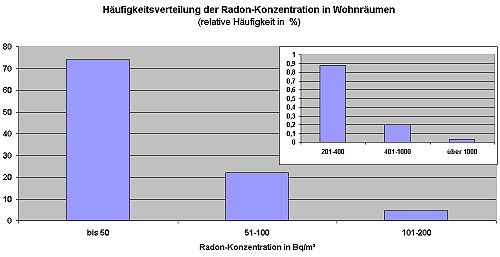
Radon in living spaces
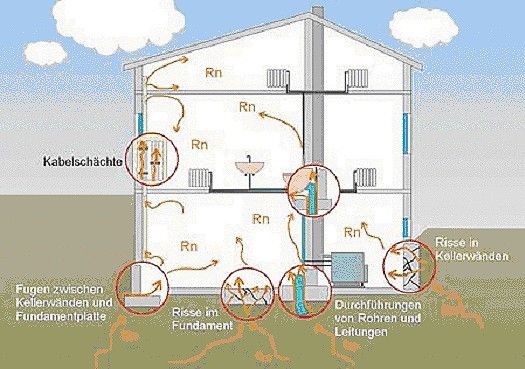
The radon concentration in indoor air is significantly influenced by soil gas, which can enter rooms through leaks in the foundation and walls. By contrast, the release of radon from uranium-containing building materials plays only a minor role in the vast majority of cases.
The geologically determined radon potential (the amount of radon available in the subsurface, corresponding to the radon concentration in the soil gas) and the radon permeability of the ground are, alongside structural conditions and usage habits, decisive causes of elevated radon concentrations occurring in buildings.
Data source: Radon-Handbuch Deutschland 2001
It is assumed that the ratio of soil air to indoor air concentration is estimated to be 1: 0.001 - 0.005, i.e. 100,000 becquerels of radon per cubic meter of soil air can cause 100 to 500 becquerels per cubic meter of indoor air. However, it should be noted that this can only be a rough estimate, because the construction (basement, thickness and material of the floor slab, etc.), the condition of the building and the type of use are also of considerable influence.
In Thuringia, measurements on the radon issue have been carried out for many years. In 1995 the Thuringian state government commissioned a study to delimit suspected radon areas in the state, the results of which are presented at www.tlug-jena.de/contentfrs/fach_07/radon/64_01010_01_radon.html. The starting point of these investigations is the soil's uranium content, which was determined by means of special measurements during the overflight of extensive areas of Thuringia and combined with a number of other factors. Further results of a nationwide survey with a total of 2,346 measurement sites on the radon concentration in the soil air (1 m soil depth), which the Federal Government had carried out within its competence, were published as a map at www.bfs.de/ion/radon/radonatlas.html.
When examining both maps, it should be noted that they can only provide a rough overview of the large-scale distribution of the radon suspicion classes or the radon concentration in the soil air. As the authors have added, they are not suitable for assessing the radon situation in a spatially limited region, a municipality or a specific building.
Therefore, the fact that a building is located in a region where there are some measurement points with elevated radon concentration does not permit the conclusion that all other buildings must also have a radon problem, or that wherever there have so far been no indications of higher radon concentrations in the soil air or where no measurements have been taken, these cannot occur locally. Conditions can vary from house to house.
Only on-site measurement of the radon concentration provides reliable information about the radon situation in a building.
The following measurements are recommended:
measuring the radon concentration in the building ground as part of new construction planning,
measuring the radon concentration in the indoor air of existing buildings.
Indoor air measurements are offered, among others, by institutions that took part in a comparative test at the Federal Office for Radiation Protection in 2004 and whose dosimeters were assessed as suitable (radon measurement centres).
The measurement of the radon concentration in the building ground is usually carried out by measuring the radon concentration in the soil air at a soil depth of 1 m. Long-term measurement methods are mostly used to measure the radon concentration in the indoor air. Long-term measurements are recommended because the radon content in the indoor air is subject to daily and seasonal fluctuations. In the winter half-year, for example, the radon concentrations in the rooms are generally higher than in the warm season. The cost of the measurement amounts to about 30 euros per measurement point, including the evaluation.
There are currently no statutory regulations on limit values for radon concentration in residential buildings in Germany.
Information on protection against radon can be found in the BfS info sheet 5/2003 or, for further reading, in the Radon-Handbuch Deutschland.
The following offer professional advice free of charge in Thuringia:
on the radon health risk in residential buildings
Thüringer Landesamt für Lebensmittelsicherheit und Verbraucherschutz
Tel.: 0361 37888 20 and 0361 37888 23
on the measurement of radon
Thüringer Landesanstalt für Umwelt und Geologie,
Landesmessstelle für Umweltradioaktivität
Messstelle Gera
Tel.: 0365 8275 728
Read more about the experiences of other customers in the Drymat case studies category.
Your inquiry to Drymat
Start your free moisture check
An expert appointment in just 60 seconds
About Drymat
Drymat is one of the leading companies in the field of masonry drying. With more than 25 years of experience, our customers rely on Drymat's expertise.

Contact
-
- Address
- Dresdner Straße 24, 09577 Niederwiesa
- Phone
- info@drymat.de
-
- Opening hours
- Mon-Fri: 08:00 - 15:00