deutsch
  deutsch (CH)
  deutsch (AT)
  russisch
  englisch
  rumänisch
  italienisch
Electrophysically active process
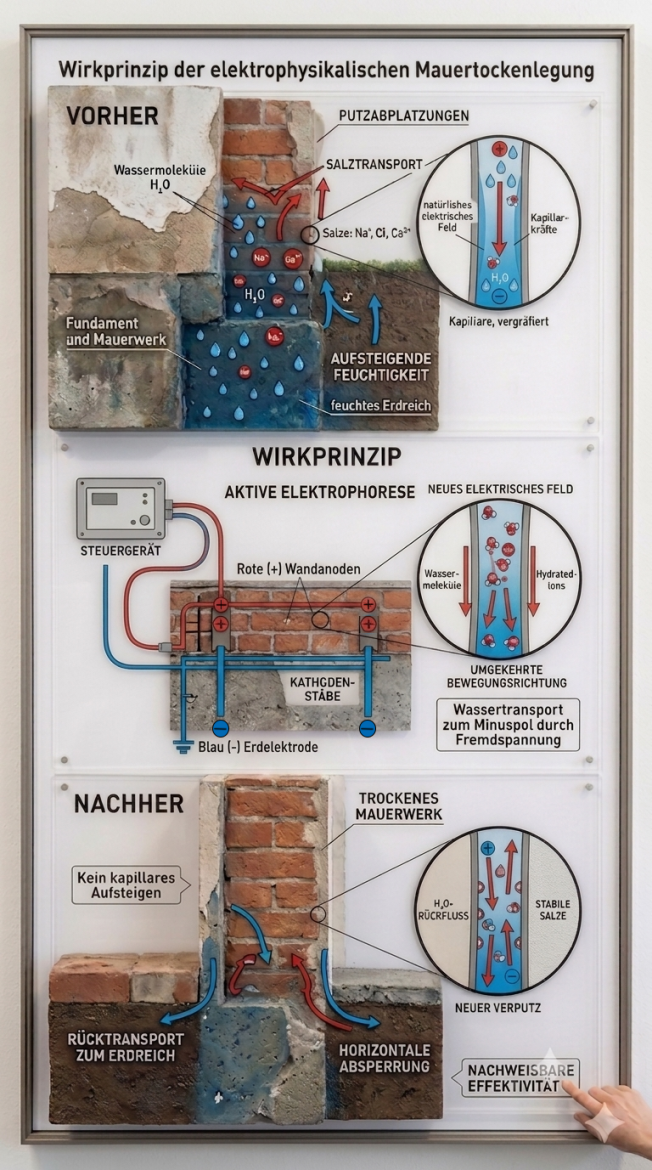
A clever barrier beneath your home.
With an electrophysical masonry-drying system based on durable precious-metal anodes, you achieve lastingly dry building fabric in a short time – without major structural work and without chemical additives. The process uses proven electrochemical principles as they have been successfully applied and described in standards for decades in cathodic corrosion protection (CCP).
The result: a healthy, comfortable indoor climate, reduced heating costs and lasting value retention for your property. The method is suitable for public, commercial and private buildings and ranks among the most effective, gentle and at the same time most economical drying processes – low-risk, standard-compliant, durable and economical, with a 20-year warranty on all installed electrodes and components.
Unlike conventional methods, the process works without chiselling or the subsequent insertion of a mechanical horizontal barrier. Especially with thick, intricate or listed walls, with rubble and natural stone, or where mechanical barriers are technically impossible, it plays to its strengths: it acts across the entire wall cross-section instead of creating just a single barrier plane. This way the moisture is not merely stopped at one line but led back out of the wall into the ground. How exactly this works – from the physical fundamentals through the precious-metal anodes to the classification under ÖNORM B 3355-2 – is explained on this page.
Electrophysically active process
Scientifically guided per ÖNORM B 3355-2
Precious-metal anodes with defined series resistance
Minimal impact on the building fabric
Suitable for nearly all masonry types – incl. rubble and natural stone
No structural risks
No chemical additives or harmful fields
Significant reduction in heating costs
Strong reduction of moisture, mould and fungi
No adverse health effects
ÖNORM B 3355-2 explicitly describes the use of electrophysical methods for masonry drying and defines requirements for:
The system meets all of the standard’s criteria and additionally builds on the technical fundamentals of cathodic corrosion protection in accordance with DIN EN ISO 12696 – technically legitimate, standard-compliant and well established.

Natural electrical potentials
Moisture generates electrical voltage fields (zeta potentials) in the building material that promote capillary rise. The system counteracts this field in a targeted way – moisture migrates back into the ground in a controlled manner.
Controlled moisture and ion transport
The DC field influences the migration of water molecules and ions: capillary rise is reduced, moisture is returned and salts are broken down (desalination effect).
Suitable for massive wall structures
The deep-acting process also reaches complex structures such as rubble stone, natural stone and extremely thick wall cross-sections – regardless of pore structure, stone mix or jointing.
Long-term stabilisation
The system keeps the masonry stable and climate-resistant over the long term – even under changing ground-moisture conditions.
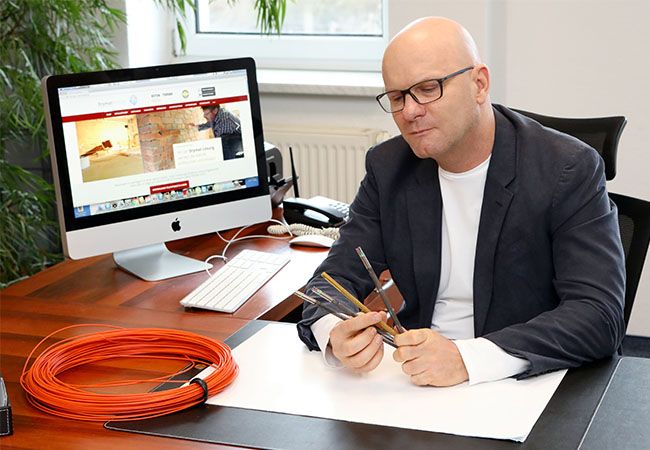
The anodes used are made of corrosion-resistant precious metals and feature a defined series resistance. This ensures an even distribution of current and prevents overloading or short circuits. They are fully embedded in certified anode mortar, which:
Below the foundation, the so-called negative poles (cathodes) are installed, creating a defined counter-pole zone. This forms a barrier line down below the foundation base, reducing the supply of moisture and effectively supporting the dehumidification.
Power consumption can be read at any time on the control unit's display and is logged over the long term. Typical power draw for a large single-family home: 10 volts at 200 mA = 2 watts.
This makes the system one of the most energy-efficient active drying processes.
Our electrophysical drying system has already been used successfully in over 10,000 buildings – including kindergartens, schools and public institutions, town halls, museums, castles and monuments, commercial and administrative buildings as well as private homes, old buildings and historic properties. The large number of completed projects demonstrates the technical reliability and long-term effectiveness of the process.
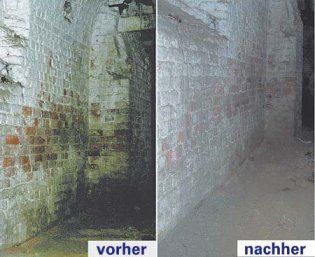
Active electro-osmosis is a physical phenomenon that has been studied scientifically for more than two centuries. It was first described in 1809 by the Russian physicist Reuss; in the following decades, Perrin, Stern, Helmholtz and Chapman, among others, developed the theoretical fundamentals of electrokinetic processes.
Would you like to know the condition of your building? Use our free, no-obligation online damage analysis – in just a few steps you record the affected areas and receive an initial assessment. Free of charge and risk-free.
An expert appointment in just 60 seconds
Drymat is one of the leading companies in the field of masonry drying. With more than 25 years of experience, our customers rely on Drymat's expertise.